
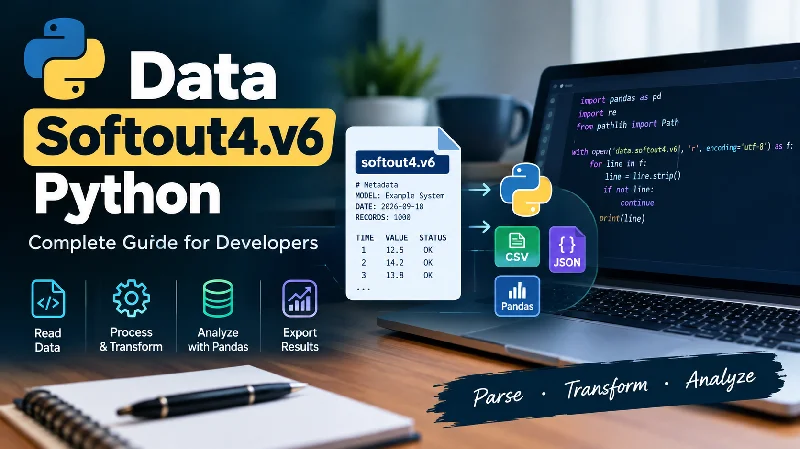
If you have recently come across the term data softout4.v6 Python, you may be wondering what it means, where it is used, and whether it is an actual Python package. The term has appeared in several recent technical articles, but its meaning isn’t consistently documented.
Some sources describe data softout4.v6 Python as a structured data-output or parsing concept, while others present it as a Python-based utility for processing semi-structured files. However, no clearly established public package with official documentation appears to exist under this exact name.
That makes it important to understand the term carefully before installing a package or adding unfamiliar code to a production project.
What Is Data Softout4.v6 Python?
Data softout4.v6 Python appears to be a technical term associated with data processing, structured output, or custom file parsing.
Several online descriptions connect the term with workflows involving:
- Data extraction
- Data transformation
- Structured output
- File parsing
- Metadata processing
- Numerical data
- Logging and validation
- Python-based automation
One recent guide describes it softout4.v6 as a semi-structured output convention rather than an installable Python package. According to that description, such files may contain metadata, numerical tables, repeated sections, and free-form text that need programmatic parsing.
Because the terminology is not standardized, developers should first identify where they encountered softout4.v6 before assuming that it refers to a particular library.
Is Data Softout4.v6 an Official Python Package?
This is one of the most important questions.
A normal public Python package can usually be identified through resources such as:
- PyPI
- GitHub or GitLab
- Official documentation
- Release history
- Package metadata
- Dependency information
- Maintainer information
Search results for the exact term do not currently establish a clearly identifiable official PyPI or GitHub project. One recent technical investigation also notes that the term may instead represent a private module, internal identifier, or project-specific format.
Therefore, you should not automatically run an installation command copied from an unverified website.
If softout4.v6 appears in an existing project, it could be an internal module that belongs specifically to that project.
Why Is the Term Difficult to Understand?
The biggest problem with data softout4.v6 Python is that different websites describe it in very different ways.
Some articles characterize it as a data-output utility. Others describe it as a file format or parsing convention, while some claim that it is a framework for data ingestion and transformation.
This inconsistency means that the safest approach is to investigate the actual source where you found the term.
For example, if your Python code contains:
from softout4.v6 import something
you should determine where that module comes from rather than assuming that softout4.v6 is a globally available Python library.
Understanding the “v6” in Softout4.v6
The v6 portion of the name may look like a conventional software version.
However, without official documentation, it is not safe to assume that it means “version 6.”
Depending on the project, it could represent:
- A module or namespace
- An internal release identifier
- A directory name
- A file-format revision
- A custom versioning system
- Part of a project-specific identifier
The actual meaning should be determined from the project documentation or source code.
How to Check Data Softout4.v6 in a Python Project
If you inherited a project that contains the term softout4.v6there are several practical ways to investigate it.
1. Search the Project Files
Start by searching for:
softout4
softout4.v6
data_softout4
Check files such as:
requirements.txtpyproject.tomlsetup.pyPipfile- Docker configuration
- Python source files
- CI/CD configuration
This can reveal whether the term is an external dependency or simply part of the project’s own source code.
2. Check Installed Packages
You can inspect your current Python environment with:
python -m pip list
You can also try:
python -m pip show softout4
If the package cannot be found, that does not necessarily mean the project is broken. The module could be local or provided by another package.
3. Locate the Imported Module
If Python successfully imports the module, inspect its location:
import softout4

print(softout4.__file__)
This can help you determine whether the code is coming from:
- Your project directory
- A virtual environment
- A third-party package
- A custom internal installation
This is often more useful than relying on a search-engine description.
Parsing Semi-Structured Data With Python
One interpretation of data softout4.v6 Python describes it as a format or convention containing mixed data structures.
For example, a file could contain metadata followed by numerical records:
MODEL: Example System
DATE: 2026-09-18
RECORDS: 1000

TIME VALUE STATUS
1    12.5  OK
2    14.2  OK
3    13.8  OK
A normal CSV reader may not be suitable for this kind of file because different sections have different structures.
Python is useful here because you can process the file line by line and decide what each section represents.
A simple starting point is:
with open("output.v6", "r", encoding="utf-8") as file:
    for line in file:
        line = line.strip()

        if not line:
            continue

        print(line)
Once you understand the structure, you can add specialized parsing logic.
Using Regular Expressions for Data Extraction
Regular expressions can be useful when specific values appear inside free-form text.
For example:
import re

line = "Precision: 0.95"

match = re.search(r"Precision:\s*(\d+\.\d+)", line)

if match:
    precision = float(match.group(1))
    print(precision)
This approach can help when a custom data file contains metadata that isn’t organized into conventional columns.
However, regular expressions should be used carefully. If the format has a formal specification, following that specification is usually more reliable than creating a collection of fragile patterns.
Working With Pandas
If the data eventually becomes tabular, pandas can make processing considerably easier.
For example:
import pandas as pd

data = [
    [1, 12.5, "OK"],
    [2, 14.2, "OK"],
    [3, 13.8, "OK"]
]

df = pd.DataFrame(
    data,
    columns=["time", "value", "status"]
)

print(df)
After parsing the original data, pandas can be used for:
- Cleaning
- Filtering
- Aggregation
- Statistical analysis
- Exporting CSV files
- Data visualization
This also illustrates an important point: you may not need a specialized package to perform the actual data processing.
Data Softout4.v6 Python and Automation
Custom data formats often become difficult when you must process hundreds or thousands of files.
Python can automate this workflow using modules such as pathlib.
For example:
from pathlib import Path

data_folder = Path("data")

for file_path in data_folder.glob("*.v6"):
    print("Processing:", file_path)
You can then connect the file-discovery process to your parser and save the results in a standard format such as CSV or JSON.
This type of workflow is useful for batch processing, testing, reporting, and data migration.
Common Mistakes to Avoid
When working with an unfamiliar term such as data softout4.v6 Python, developers can easily make assumptions that cause unnecessary problems.
Installing an Unverified Package
Do not install a package simply because a blog provides a command such as:
pip install something
First verify the package name, source, maintainer, documentation, and project repository.
Assuming the Import Name Is the Package Name
Python import names and package distribution names are not always identical.
For example, the name used in:
import example
does not necessarily tell you the exact name that was used to install the package.
Trusting Unsupported Version Claims
Some pages discussing this keyword make claims about features attributed to future or nonexistent Python versions. Those claims should be independently verified against authoritative Python documentation rather than copied into production code.
Skipping Sample-File Testing
If softout4.v6 refers to a custom output format, always test your parser against multiple real files.
A parser that works on one example may fail when:
- A field is missing
- A header changes
- A new record type appears
- Extra whitespace is introduced
- A file is incomplete
- Numerical values use a different format
Alternatives to Data Softout4.v6 Python
If your goal is simply to process data, established Python tools may already provide everything you need.
Pandas
Pandas is useful for structured and tabular data.
NumPy
NumPy is useful for numerical calculations and array-based processing.
Regular Expressions
Python’s built-in re module is useful for extracting patterns from semi-structured text.
JSON
Python’s built-in json module is useful when your data is already structured as JSON.
pathlib
The pathlib module is useful for locating and processing large collections of files.
Using established tools can make your application easier to maintain, especially when there is no clear documentation for an obscure dependency.
Is Data Softout4.v6 Python Useful?
The answer depends on what data softout4.v6 actually refers to in your particular environment.
If it is a private module or custom file format, Python can certainly parse, transform, validate, and export the associated data.
If you found the term in an online article and are considering installing a package with that name, verify its authenticity and documentation first.
The most important lesson is not to confuse a search-engine keyword with an officially documented Python technology.
Final Thoughts
Data softout4.v6 Python is an unusual keyword because online sources do not provide a single consistent definition. Some descriptions present it as a data-output utility, while others treat it as a custom or semi-structured data format.
For developers, the safest approach is to investigate the actual project, file, import statement, or documentation where the term appears.
Rather than relying on an unverified installation command or unsupported feature claims, identify the module’s source first. Once you know the underlying format or software component, standard Python tools such as pandas, NumPy, regular expressions, and built-in file-handling modules can often reliably process the data.
Frequently Asked Questions
What is data softout4.v6 Python?
Data softout4.v6 Python is an obscure technical term associated in online sources with data processing, structured output, or custom file parsing. Its exact identity is not consistently documented.
Is softout4.v6 a Python library?
There is currently insufficient evidence to treat it softout4.v6 as a clearly established public Python library. It may instead refer to a private module, custom format, or project-specific identifier.
Can Python parse softout4.v6 data?
Yes. If the term refers to a custom or semi-structured data format, Python can read files, identify sections, extract values, validate records, and convert the results into formats such as CSV or JSON.
Do I need pandas?
Not necessarily. Pandas is useful when your final data is tabular, but Python’s built-in file handling re, json, and pathlib modules may be sufficient for simpler workflows.
How can I identify what softout4.v6 means in my project?
Search the project’s dependency files and source code forsoftout4, inspect the installed Python environment, and use module.__file__ to identify where an import is coming from.
Pingback: How Is a Live Dealer Table Streamed to Ontario Real-Money Players?