
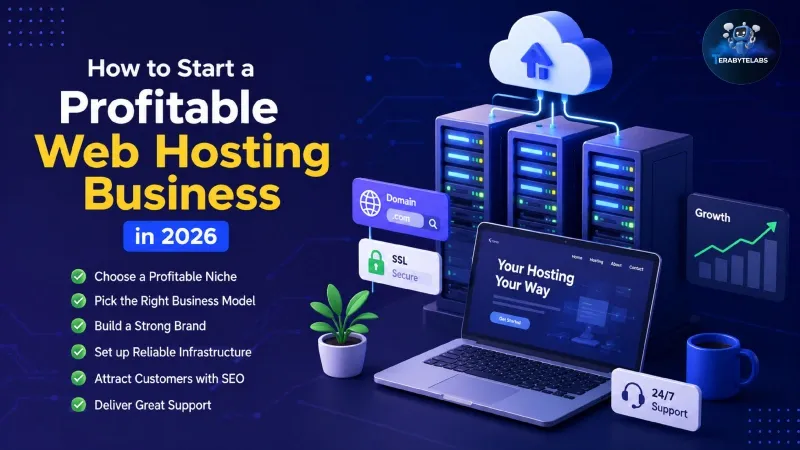
Do you know the web hosting industry is growing rapidly in 2026? Because every online business needs a reliable place to run its websites, store data, and stay accessible to visitors.
Nowadays, every business moves online. Creators launch personal brands, and eCommerce stores expand globally.
This creates an opportunity for entrepreneurs who want to build a profitable hosting business. You don’t need a huge amount of capital for that purpose. You need the right strategy, tools, and positioning to grow your hosting company. And it will be a stable source of recurring income for you.
In this article, we wil learn how to start a profitable web hosting business in 2026 step by step.
Understand How the Hosting Business Makes Money
It is wise to know the business model before launching.
The majority of hosting providers get their income through recurring monthly or yearly subscriptions. Clients pay to host their websites emails apps, or stores on your servers.
Common revenue sources are:
- Shared hosting plans
- Cloud VPS hosting
- Managed WordPress hosting
- Domain registration
- SSL certificates
- Website migration services
- Backup and security add-ons
- Premium support packages
The biggest advantage of this business model is the consistent stream of revenue. A satisfied client can keep coming back for years.
Select a Profitable Niche
Attempting to cater to everyone is an error. It has been shown that new enterprises quickly develop when they specialize in a niche market.
Profitable niche examples are:
- Hosting for WordPress websites
- Hosting for agencies and freelancers
- eCommerce hosting
- Gaming server hosting
- Hosting for local businesses
- Managed hosting for non-technical users
- Developer-focused VPS hosting
A niche is the perfect way for you to be noticed in a saturated market and it considerably simplifies marketing.
Decide Your Business Model
There are totally different routes that you may begin with.
Reseller Hosting
You lease server capacity from a big provider and promote hosting services under your own brand.
Good for:
- Small starting capital
- Quick launch
- Beginners
VPS or Dedicated Infrastructure
You decide to rent or purchase servers and have a hands-on approach to everything.
Good for:
- Profit percentage increase
- Getting total control
- Custom plans
Cloud-Based Hosting
The way it works is that you go after cloud platforms to get resources scalable to your customers’ growth.
Good for:
- Flexible growth
- High uptime
- Modern infrastructure
Indeed, for many startups in 2026, reseller hosting or cloud VPS is the smartest starting point.
Build the Right Technology Stack
A high level of service quality is very much reliant on the technologies we.
Choose:
- Reliable data centers
- Fast SSD or NVMe storage
- Good bandwidth
- DDoS protection
- Daily backups
- Server monitoring tools
Adopting a professional web hosting control panel makes it very simple to manage account creation, websites, email setup, backups, security, and billing. It also enhances the overall customer experience.
Choose a Strong Brand Name and Identity
Often, the importance of branding is not realized by many beginners.
Choose a name that is:
- Easy to remember
- Professional sounding
- Relevant to technology or trust
- Available as a domain name
Then build:
- Clean logo
- Consistent colors
- Professional website
- Clear messaging
People buy hosting from brands they trust.
Create Hosting Plans That Sell
Do not overwhelm customers with too many options.
Offer 3 simple choices first:
Starter Plan
Suitable for personal blogs and smaller websites.
Growth Plan
Appropriate for businesses and expanding sites.
Premium Plan
Designed for eCommerce or heavy visitors. Offer perks like:
- Free SSL
- Free migration
- Daily backups
- Fast support
- Easy one-click installs
Less is more when it comes to plans.
Price for Profit, Not Just Cheapness
Almost all beginners want to attract customers through the lowest prices.
However, it does not work out that way. Cheap customers normally ask for more support and are less loyal.
So, set the prices by the features you offer:
- Better uptime
- Faster speeds
- Helpful support
- Security features
- Easy management
You can make better profit margins if you combine a higher price with a good service.
Build a High-Converting Website
Your website is your primary selling tool. It is expected to have:
- Fast loading speed
- Nice homepage layout
- Pricing tables
- Testimonials
- Live chat or contact form
- FAQ section
- Trust badges
- Refund policy
Concentrate on clarity. Visitors should know what you are offering within the first few seconds.
Invest in Customer Support
Customers who rely on hosting want their issues solved immediately. Extremely bad support can ruin a company’s image extremely fast.
Provide:
- Email support
- Ticket system
- Live chat if possible
- Knowledge base
- Setup guides
Quick, courteous, and helpful support turns into a source of growth because satisfied clients easily refer others.
Employ SEO to Attract Free, Long-Term Customers
A search engine traffic may become your channel that brings you the highest profits most of the time.
You can write content based on keywords like:
- Best hosting for small business
- Fast WordPress hosting
- VPS hosting for startups
- Secure hosting for eCommerce
- How to migrate a website
Make publishing guides tutorials comparisons, and case studies with extremely helpful information.
It may take months to see results, but when SEO gets to work, the costs for acquiring customers drop very much.
Use Paid Ads Carefully
Paid ads can move the needle, just don’t pour cash into them blindly.
Beginners usually end up losing funds before they even see returns.
Launch gently with google Search, Facebook, Instagram, YouTube, and retargeting campaigns.
Drive visitors to specific landing pages instead of cluttered homepages.
Measure cost per lead, cost per sale, and lifetime value of each customer.
Offer Upsells and Add-Ons
Grow only what brings profit to the bottom line.
Bundle extras to boost income – like site maintenance, malware scans, performance tweaks, priority help, more space, email setups, or SEO tools.
These upsells stretch how much money each client brings in over time.
Cancellations hurt far more than new signups ever do.
Keep Churn Low
Fight churn by running uptime checks, fixing load times, offering quick support, sending renewal notices early, giving discount renewals, and helping clients expand their sites.
Real profits come from holding onto people – not gaining new ones every month.
Saving time cuts labor costs dramatically when done right.
Automate Operations
- Routine tasks like billing cycles, account renewals, suspending late bills, welcome messages, backup runs, and alert flags can run on autopilot.
- More automation means growing without needing more hands on deck.
Security Provision
In 2026, trust built around safety is what drives sales.
People look for strong antivirus shields, encrypted logins, daily file copies, separate user zones, attacks blocked at scale, and secure login flows.
Common Mistakes to Avoid
Do not:
- Rely solely on the lowest price to win customers.
- Turn a blind eye to the staff supporter quality.
- Sell server resources more than what the client actually needs.
- Start a business without having backup copies of the data.
- Go for a sloppy branding.
- Forget about SEO.
- Make a promise about uptime that is not achievable.
In fact, staying away from these mistakes can keep you out of trouble for quite a long time.
Growth Strategy for Year One
An achievable plan for the first year:
1-3 months
- Launch a brand
- Build a website
- Get first 10 clients
4-6 months
- Improve support system
- Add reviews
- Publish SEO content weekly
7-9 months
- Run paid campaigns
- Introduce upsells
Months 10–12
- Optimize churn
- Upgrade infrastructure
- Scale winning channels
Steady progress beats chasing shortcuts
Final Thoughts
Launching a successful web hosting company in 2026 is still a good chance to make money. The demand is increasing, and the idea of getting repeat income from customers is what makes this business model very attractive. What leads to winning in business is finding a spot that is not too crowded, having a solid backend, giving great support, and doing marketing all the time.
Being the biggest is not the only way to win. What really matters is being a person or a company that the target audience can trust, rely on, and find helpful.
The key is to identify a good target market, provide very good service, and maintain the relationships for a long time. This is the path a hosting startup can take to become a profitable business.