
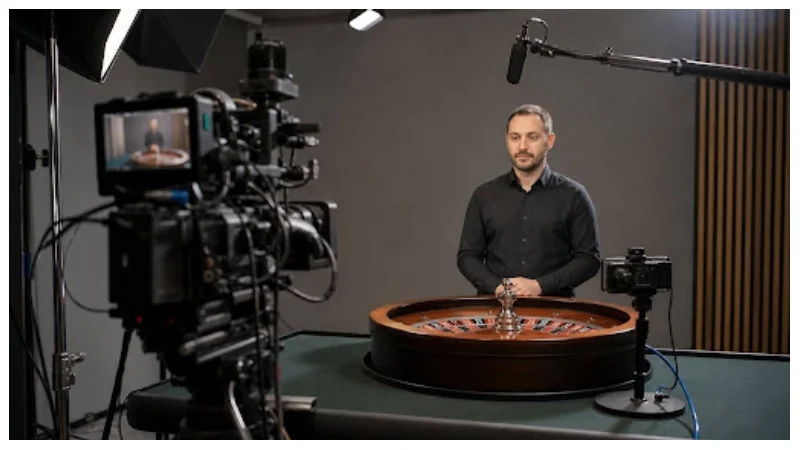
A dealer addresses the camera, the wheel begins to turn, and the picture cuts closer to the ball. Moments later, a slow-motion replay shows its final bounces before it settles into a pocket. The sequence borrows from sports television, where a wide shot establishes the scene and a close-up draws attention to the action. Behind the roulette table, cameras, microphones, lighting, and staff turn a physical game into a broadcast that also responds to input from remote players.
The Table Has to Work as a Set
In a live roulette broadcast, the dealer and wheel share the screen with a digital betting interface. Making that arrangement look clear starts with the room itself: where the cameras sit, how light falls across the table, and what appears behind the presenter.
A reporter visiting a Pennsylvania studio found five gaming tables inside a 286-square-foot room. Boom microphones hung from the ceiling, lights were angled to reduce shadows, and cables and monitors filled the space around them.
The camera view made the room appear spacious. Outside its frame, equipment was packed tightly around the tables.
Keeping the picture consistent takes regular attention. Studio video specialists install cameras and lenses, maintain cables and processing connections, and work with focus, exposure, and color balance.
Camera Changes Follow the Spin
With the set ready, the next task is deciding how viewers see the round unfold. Multiple cameras provide different views, allowing the presentation to move from the dealer to close coverage of the wheel.
Roulette formats with changing camera sequences and slow-motion replays appeared in 2013. Evolution’s Immersive Roulette, launched that year, uses 200-frames-per-second HD footage and automatic shot sequences, which vary the combination of views between spins.
Frame rate means the number of individual images captured each second. Capturing more images gives a slow-motion replay more detail as the ball bounces and comes to rest.
The replay performs a familiar television job: it lets viewers examine a brief event after seeing it happen at normal speed. A few seconds at the wheel become a sequence with several perspectives. Studios such as Playtech and Pragmatic Live, whose tables appear in ToonieBet’s live lobby for Canadian players outside Ontario, also broadcast roulette from multiple camera angles.
The Dealer Works to the Camera
Those camera changes depend on someone conducting the round while speaking clearly to an audience. The dealer has to follow game procedures and maintain an even presentation as the action moves forward.
Studio job descriptions combine dealing with on-camera hosting. Duties include addressing online participants, following production standards, and keeping games moving smoothly. Professional lighting and working directly to a camera are part of the setting.
Conversation arrives through a different channel. Players type messages into chat, while the dealer responds through a microphone. That means reading and answering written comments while continuing to speak to everyone watching.
Supervisors outside the shot provide support. At the Pennsylvania studio, pit bosses monitored games from a control room, giving them a view of activity across the tables.
The Result Has to Reach the Screen
When the ball settles, the physical outcome needs to reach the software handling the online round. The result is recorded and passed to the platform responsible for player accounts.
The Michigan Gaming Control Board’s live-game framework sets out requirements for that process. Results must be recorded before they are posted to the internet gaming platform. Pre-launch testing also examines the timing between the audiovisual signal and the user interface.
For the production team, this joins two responsibilities: showing the spin clearly and keeping the picture aligned with the interactive game.
Michigan also requires equivalent-quality video and audio feeds for participants, along with minimum connection requirements. The broadcast must work across remote devices while preserving the round’s operation.
Each Round Leaves a Record
Once the result appears, a record must still be preserved. Michigan requires continuous, unobstructed surveillance footage detailed enough to check procedures and reconstruct games. Recordings must be kept for a period set by the board.
That footage serves the review process. If a complaint or dispute arises, the recordings help establish what happened during the round. The close-up chosen for the audience and the information needed for an investigation have different purposes within the same operation.
The polished screen presentation also deserves perspective. Roulette involves financial risk. Anyone choosing to gamble should set money and time limits and contact local gambling-support services if play causes distress or financial pressure.
By the next spin, the cameras are ready again. The dealer remains the visible face of a production supported by technicians, supervisors and recording systems, all working around the same wheel.